What Is Freedom?
The Question the French Revolution Could Never Answer.

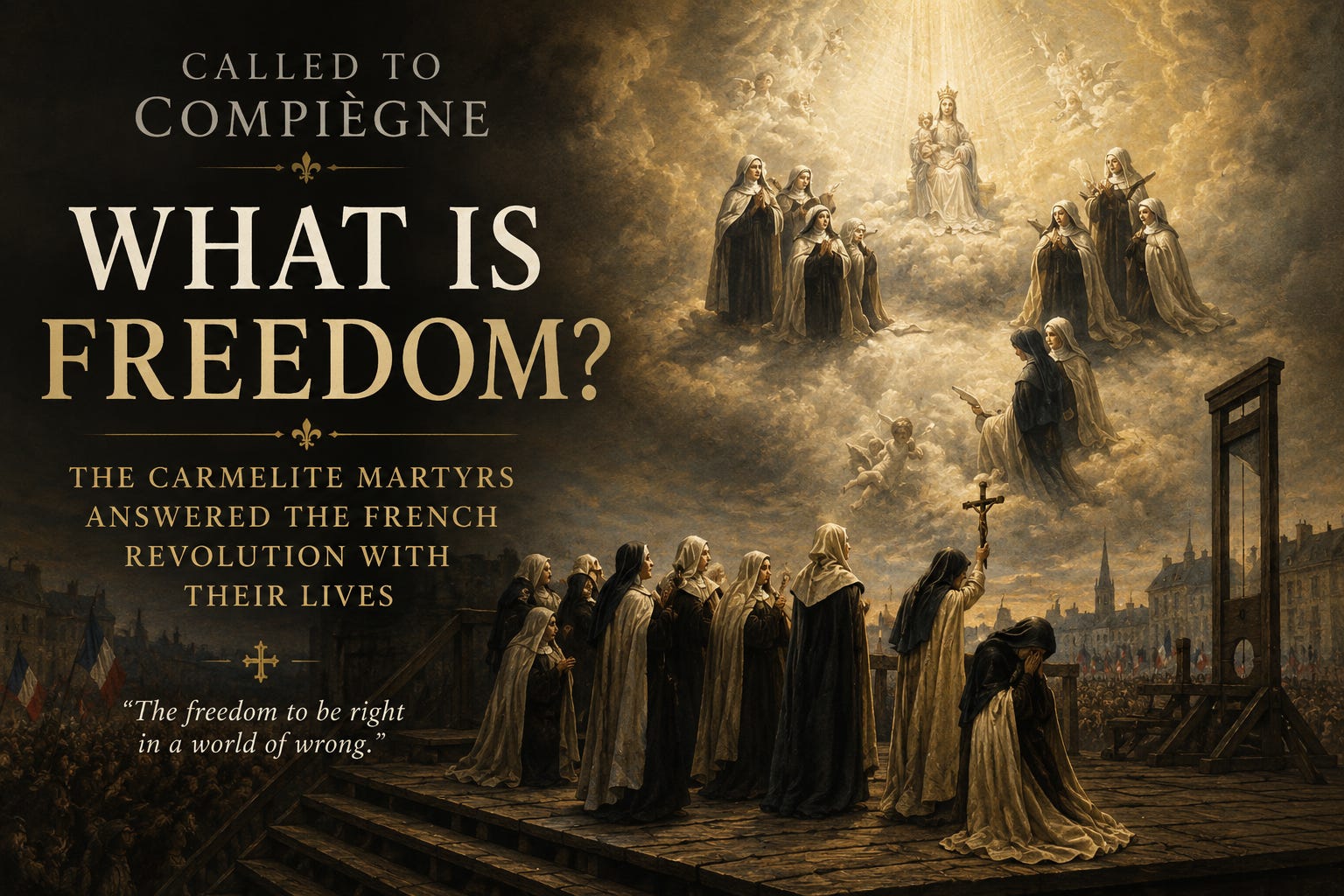
There are moments in history when an entire civilization is built upon a single idea.
For the French Revolution, that idea was freedom.
It appeared everywhere.
On banners.
In speeches.
In newspapers.
On the lips of politicians.
The old order had to be swept away, they insisted, so that mankind could finally be free.
The monarchy was the enemy of freedom.
The Church was the enemy of freedom.
Religious vows were the enemy of freedom.
Tradition itself was the enemy of freedom.
It was an intoxicating message.
Who could oppose liberty?
Who would argue against freedom?
Yet as I continued reading Called to Compiègne, I found myself asking a different question.
If the Revolution was truly about freedom...
Why was it so afraid of sixteen cloistered nuns?

The women of Compiègne owned almost nothing.
They had surrendered wealth.
Position.
Inheritance.
Marriage.
Ambition.
Comfort.
Even their clothing belonged to the community.
By every modern standard, they appeared to be the least free people in France.
And yet they possessed something the revolutionaries desperately lacked.
Peace.
It radiates from the pages.
Not because they were unaware of danger.
Not because they ignored the gathering storm.
But because their peace rested on something no government could confiscate.
They belonged to Christ.
One of the quiet strengths of this book is that it allows history to unfold patiently.
The revolutionary decrees do not arrive all at once.
They come gradually.
Almost reasonably.
The National Assembly suppresses religious orders whose members take only simple vows. Soon afterward, even solemnly professed contemplative communities find themselves under increasing scrutiny. Civil authorities begin treating monasteries not as sacred places dedicated to God, but as institutions to be reorganized, inspected, or dissolved in the name of the new order.
That pattern felt strangely familiar.
Rarely does a society abandon its foundations overnight.
It usually happens one decree at a time.
One compromise.
One redefinition.
One law that sounds harmless enough.
Until suddenly everything has changed.
The Revolution insisted that the sisters were not truly free because they had chosen obedience.
That idea has never really disappeared.
We still hear it today.
“If you follow the Church, you aren’t thinking for yourself.”
“If you obey God’s commandments, you’re limiting your potential.”
“If you submit your life to Christ, you’ve surrendered your freedom.”
How often is freedom defined simply as the absence of restraint?
Do whatever you want.
Become whoever you wish.
Answer to no one.
It sounds liberating.
Until we ask one simple question.
Has it made us happier?
Our age enjoys more choices than any civilization in history.
We can choose careers, cities, entertainment, identities, opinions, even how we spend nearly every waking hour.
Yet anxiety, loneliness, addiction, and despair continue to rise.
Perhaps unlimited choice is not the same thing as freedom.
Christ offers another definition.
“If the Son therefore shall make you free, you shall be free indeed.”
— John 8:36
Notice what He does not promise.
He does not promise unlimited options.
He promises liberation from sin.
From fear.
From slavery to our passions.
From death itself.
That is the freedom the Carmelites possessed.
No revolutionary tribunal could grant it.
No revolutionary tribunal could take it away.
As I reflected on these chapters, I realized something that had never occurred to me before.
The revolutionaries were surrounded by weapons.
The Carmelites were surrounded by silence.
Yet it was the revolutionaries who seemed afraid.
They feared monasteries.
They feared habits.
They feared crucifixes.
They feared priests.
They feared women whose entire lives were hidden from public view.
What kind of government fears prayer?
Only one that senses there is a power greater than its own.
History repeatedly teaches the same lesson.
Tyranny always fears what it cannot control.
And there is nothing more difficult to control than a conscience wholly surrendered to God.
The irony is almost impossible to miss.
The Revolution proclaimed liberty while demanding conformity.
The sisters embraced obedience while remaining inwardly free.
One side possessed political authority.
The other possessed moral authority.
Only one of those has endured.
The decrees have faded into history books.
The witness of the Carmelites continues to inspire believers more than two centuries later.
Power is temporary.
Truth has a longer memory.
Perhaps that is why this story feels surprisingly contemporary.
Most of us will never stand before a revolutionary tribunal.
Our tests are quieter.
We remain silent when we should speak.
We soften difficult truths to avoid criticism.
We compromise convictions because we fear exclusion.
Sometimes the greatest prison is not built of stone.
It is built from the opinions of other people.
The Carmelites remind us that freedom begins the moment we stop asking, “What will everyone think?” and begin asking, “What does Christ ask of me?”
That question changes everything.
One sentence lingered with me long after I closed the book.
Not because it was printed on the page.
Because it seemed to emerge from the lives of these women themselves.
Freedom is not the ability to do whatever we desire.
Freedom is the ability to desire what is good.
That is a profoundly Catholic understanding of liberty.
It is also one our culture desperately needs to recover.
The Revolution believed freedom meant casting off every bond.
The saints understood that the greatest freedom comes from binding ourselves to the One who made us.
As the pressure on the monastery increases, the sisters will soon face a choice.
Leave.
Compromise.
Or remain faithful, whatever the cost.
History remembers their decision.
But before we reach the scaffold, we must first walk through the slow tightening of the net.
Because persecution rarely begins with executions.
It begins with small demands that seem easier to accept.
And that is where our story turns next.